Direct answer
Effective Amazon DSP driver recruitment requires a repeatable pipeline that connects workforce planning, accurate job promotion, prompt applicant follow-up, consistent screening, interview scheduling, required checks and training coordination, onboarding administration, and early retention. Administrative work can be delegated, but the DSP remains the employer and keeps responsibility for employment policies, candidate assessment, compensation, and the final hiring decision.
Key takeaways
- Work backward from expected routes, current active drivers, attendance patterns, turnover, training lead time, and reserve needs; do not rely on a universal driver-to-route ratio.
- Assign one owner and one next action to every applicant so candidates do not disappear between screening, interview, checks, training, and onboarding.
- Use the same job-related screening questions and decision criteria for candidates applying to the same role.
- Separate administrative coordination from employment decisions and from steps controlled by Amazon or another third party.
- Treat the first week as part of recruitment: clear schedules, payroll setup confirmation, a manager handoff, and an early check-in protect the work already invested in hiring.
What does Amazon DSP driver recruitment include?
Amazon DSP driver recruitment is the operating process a Delivery Service Partner uses to attract, assess, select, prepare, and retain delivery-associate candidates. It starts before a job is posted and continues through the candidate's first week. The practical work includes headcount planning, job-listing administration, applicant communication, first-level screening, scheduling, outcome tracking, next-step coordination, onboarding administration, and reporting.
The ownership boundary matters. Amazon describes DSPs as independent businesses that hire and develop their drivers. Amazon's driver-jobs information also states that each DSP is independently responsible for hiring, performance management, and termination. A recruitment vendor can organize and execute agreed administrative steps, but it does not become the employer or replace the DSP's judgment.
Evidence note: The guide treats the DSP as the employer and final decision-maker. That distinction is based on Amazon's own public descriptions of the DSP model. Amazon source.
Why do DSP driver hiring pipelines break down?
Most hiring pipelines do not fail at one dramatic point. They lose candidates through a series of small handoff failures. A job board may produce applicants, but the pipeline still stalls when nobody owns the first response, screening notes live in separate inboxes, interview outcomes are not recorded, or a candidate receives no update while a third-party step is pending.
- Slow applicant response: applications sit unassigned while candidates continue considering other work.
- Unclear ownership: recruiters, managers, and administrators assume somebody else is taking the next step.
- Inconsistent screening: different candidates receive different questions, producing notes that cannot be compared fairly or reliably.
- Interview no-shows: candidates do not receive a clear confirmation, location, time, format, or simple way to reschedule.
- Incomplete documents: missing or incorrect items are discovered late instead of being flagged with a clear owner and due date.
- Delayed status follow-up: pending checks, training, or approvals remain open without a scheduled review.
- Poor pipeline visibility: managers know the total application count but cannot see how many candidates can realistically reach a start date.
- Weak first-week communication: new hires reach day one without clear schedule, payroll, manager, or escalation information.
- Peak-season pressure: application volume grows faster than the team can screen, schedule, and close loops.
How should a DSP plan recruitment capacity?
Start with an operating forecast, not a generic staffing ratio. Route demand, schedule design, local attendance, turnover, training timing, and the number of people you want available as reserve coverage vary by station and season. The useful output is a documented hiring target with assumptions that managers can revisit each week.
Write the assumptions beside the target. If routes increase, training is delayed, or active availability changes, the owner can update the target without pretending the original forecast is still valid. The planning meeting should end with a weekly intake goal and an owner for each pipeline stage, not only a headcount number.
What is the end-to-end Amazon DSP hiring workflow?
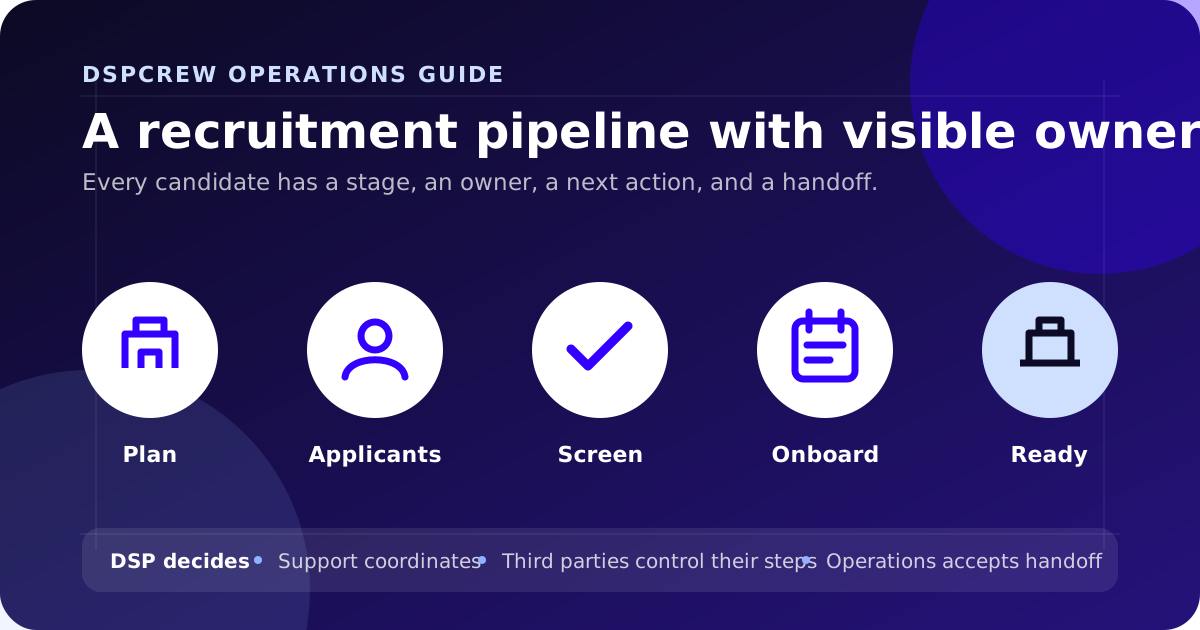
The workflow below is intentionally platform-neutral. The DSP should adapt it to the current tools, Amazon-provided processes, provider requirements, and applicable law. Each stage needs an outcome, an owner, and a defined next action.
-
Define weekly hiring needs
Translate the route and staffing forecast into the number and timing of starts the DSP wants to pursue.
Ownership: DSP management approves the target; administrative support can maintain the forecast.
-
Prepare accurate job listings
Describe the employer, work location, schedule expectations, compensation information approved by the DSP, core duties, and a clear application path.
Ownership: The DSP approves the offer and employment terms; support can prepare and post approved copy.
-
Capture and organize applicants
Route every applicant into one controlled pipeline and prevent duplicate or orphaned records.
Ownership: Administrative support can maintain the applicant record system.
-
Contact applicants promptly
Acknowledge the application, explain the next step, and give the candidate a reliable way to respond or reschedule.
Ownership: Administrative support can handle approved outreach.
-
Conduct first-level screening
Use consistent, job-related questions and record factual answers without making the final employment decision.
Ownership: Support can administer the screen; the DSP owns the criteria and decision.
-
Schedule interviews or orientations
Confirm format, location, time, expected duration, preparation, and the rescheduling path.
Ownership: Support can coordinate calendars and reminders.
-
Record outcomes
Capture attended, rescheduled, no-show, advance, hold, or closed outcomes and the next action due.
Ownership: The interviewer records assessment; support maintains the pipeline.
-
Coordinate next-step requirements
Send the approved instructions and track whether the candidate completes each required action.
Ownership: Support coordinates; the DSP and relevant provider control decisions.
-
Track checks, training, and documentation
Monitor status without interpreting results or bypassing provider, Amazon, legal, or policy requirements.
Ownership: Third parties control their steps; the DSP owns employment action; support tracks status.
-
Complete onboarding administration
Follow the DSP's approved checklist, flag incomplete items, and keep sensitive records only in authorized systems.
Ownership: Support can administer; the DSP and its HR or payroll providers set requirements.
-
Hand the candidate to operations
Confirm the manager, schedule, work location, readiness status, and open issues before the first shift.
Ownership: DSP operations accepts the handoff.
-
Monitor the first week
Confirm attendance, scheduling clarity, payroll setup, manager connection, and any issue requiring escalation.
Ownership: DSP management owns employment decisions; support can coordinate check-ins and documentation.
What should a first-level applicant screen confirm?
A first-level screen should collect job-related information the DSP has approved for the role. It should not ask for medical or genetic information, invite discussion of protected characteristics, or attempt to replace the DSP's legal and HR review. Use the same core questions for candidates applying to the same job and document answers neutrally.
| Screening area | What to confirm | Follow-up need | Decision owner |
|---|---|---|---|
| Role understanding | Candidate understands the delivery role and the duties stated in the approved listing. | Questions or expectations do not match the posted role. | DSP management |
| Schedule availability | Availability matches the shifts and start window the DSP approved for recruiting. | Availability is incomplete or needs a manager exception. | DSP management |
| Work location | Candidate understands the station or reporting location and can reliably report there. | Location is unclear or the candidate requests an arrangement not covered by the listing. | DSP management |
| Communication | Preferred contact method and a reliable time for the next step. | Candidate needs an accommodation or another communication format. | DSP/HR process owner |
| Job-related requirements | Only the requirements in the DSP-approved role description are reviewed. | A response needs HR or legal interpretation rather than recruiter judgment. | DSP/HR counsel |
| Process readiness | Candidate is willing to complete the next required steps and understands that requirements may be controlled by other parties. | Candidate cannot meet the stated timeline or needs clarification. | DSP management / third party |
What candidate communication cadence keeps the process moving?
A cadence is an operating example, not a legal mandate or a promise that every candidate will follow the same timeline. Adjust it to the DSP's approved process and to steps controlled by Amazon or other providers. Every message should identify the employer correctly, explain the next action, and offer a clear way to ask a question or reschedule.
| Touchpoint | Purpose | Include | Record |
|---|---|---|---|
| Initial response | Confirm receipt and reduce uncertainty. | Employer name, role, next step, response path. | Sent date and next-action due date. |
| Screening invitation | Make the screen easy to complete. | Format, available times, expected duration, reschedule path. | Selected time and owner. |
| Interview reminder | Prevent avoidable confusion. | Confirmed date, time, location or link, contact person, preparation. | Reminder status and candidate confirmation. |
| Missed-interview follow-up | Close the loop without assuming intent. | One clear rescheduling option and a response deadline chosen by the DSP. | Outcome and next action. |
| Next-step reminder | Keep required actions visible. | Only approved instructions, due date, support contact, and dependency. | Completion or escalation status. |
| Onboarding reminder | Reduce incomplete first-day setup. | Approved checklist, secure submission path, and open items. | Items complete, missing, or under review. |
| First-day confirmation | Complete the handoff to operations. | Reporting time, location, manager, schedule, and question channel. | Confirmation and unresolved issue. |
What should an Amazon DSP recruitment dashboard track?
The dashboard should answer two questions without a meeting: where is each applicant, and what must happen next? A total applicant count cannot do that. Use mutually understood stages and require every active record to have an owner, last-contact date, next action, due date, and concise factual notes.
| Stage | Stage is complete when | Typical next action |
|---|---|---|
| New applicant | The application is captured and deduplicated. | Assign outreach. |
| Contacted | An approved first contact has been sent or completed. | Book screening or schedule follow-up. |
| Screening scheduled | A time and method are confirmed. | Send reminder and conduct screen. |
| Screened | The approved questions and factual notes are complete. | Route to DSP decision-maker. |
| Interview scheduled | Candidate and interviewer have a confirmed time and place. | Send reminder and prepare interviewer. |
| Interview completed | The interviewer recorded the outcome. | Close, hold, or begin next steps. |
| Next steps pending | The DSP has chosen to advance and instructions were issued. | Track external and candidate actions. |
| Onboarding in progress | Approved onboarding tasks have started. | Resolve incomplete items. |
| Training pending | Training is required but not yet completed. | Track the controlling party's status. |
| Ready for start | The DSP has confirmed the person may be handed to operations. | Complete first-day confirmation. |
| Hired | The DSP records the employment outcome in its authorized system. | Begin first-week follow-up. |
| Inactive or closed | The DSP's approved closure reason is recorded. | Retain or dispose of records under approved policy. |
What belongs on a driver onboarding administration checklist?
The checklist should mirror the DSP's current official requirements and the systems it is authorized to use. It is a coordination tool, not a substitute for Amazon instructions, insurer requirements, payroll-provider instructions, employment counsel, or applicable law.
Reusable onboarding administration checklist
- Confirm the candidate record uses the correct legal name and secure contact information in the authorized system.
- Confirm the DSP-approved offer, role, work location, compensation, and expected schedule have been communicated through the approved process.
- Track completion of required forms without copying sensitive data into informal notes or spreadsheets.
- Confirm payroll setup status with the approved payroll or HR provider and flag, rather than interpret, any exception.
- Track background-check, drug-test, motor-vehicle, or other provider-controlled steps only when they are part of the DSP's actual approved workflow.
- Track required training or orientation status and keep the source of truth clear.
- Confirm policy acknowledgements and driver-file items specified by the DSP's HR process.
- Record incomplete items, the person responsible, the next action, and the due date.
- Complete the operations handoff with reporting time, location, manager, and any unresolved administrative issue.
- Send the first-day confirmation and schedule the first-week check-in.
Always reconcile this working checklist against the DSP's current official Amazon resources, HR and payroll providers, insurer requirements, and qualified counsel.
How does the first week support driver retention?
A candidate who accepts the role is not yet an operationally settled employee. The first week is where expectations, systems, and manager communication meet. Recruitment administration should close only after operations confirms that the handoff worked.
- Pre-start communication: reconfirm the date, time, location, manager, and a working contact channel.
- First-day expectations: explain what the new hire should expect based on the DSP's approved onboarding and training plan.
- Manager handoff: name the operations owner and transfer open issues instead of leaving the candidate with a recruiter-only contact.
- Scheduling clarity: verify the new hire can see the schedule and knows how the DSP handles approved questions or changes.
- Payroll setup confirmation: verify status through the authorized provider and escalate missing information securely.
- Escalation contact: give the employee a clear route for administrative or manager questions.
- Early check-in: use a short, documented conversation to surface confusion before it becomes an attendance or payroll issue.
- Issue documentation: record facts, owner, next action, and resolution in the appropriate system.
This process does not guarantee retention. It removes avoidable ambiguity and gives management earlier visibility into problems it can address.
Should Amazon DSP recruitment stay in-house or be outsourced?
Neither model is automatically better. The right choice depends on management capacity, local recruiting knowledge, process maturity, volume volatility, data access, and how clearly responsibilities can be divided. Some DSPs use a hybrid model: managers keep interviews and hiring decisions while support handles pipeline administration and candidate coordination.
| Consideration | In-house team | External support |
|---|---|---|
| Direct control | Managers can change priorities immediately and own every candidate interaction. | Requires a clear service scope, escalation path, and approved messaging. |
| Local knowledge | Strong when the team knows the station, labor market, and manager preferences. | Must be transferred during onboarding and maintained through regular reviews. |
| Recruitment process experience | Depends on the people assigned and the consistency of their workflow. | May provide a specialized process and dedicated administrative coverage. |
| Management burden | Leaders directly manage postings, follow-up, scheduling, records, and reporting. | Can reduce recurring coordination work while leaving decisions with management. |
| Coverage | Can be highly responsive when trained staff are consistently available. | Can add continuity when station managers are focused on daily operations. |
| Scalability | May require hiring or reallocating internal staff as volume changes. | May flex within the agreed scope, capacity, and commercial terms. |
| Reporting | Can fit existing management systems exactly if maintained consistently. | Should provide a defined pipeline report and data-access arrangement. |
| Cost structure | Includes compensation, management time, tools, training, and coverage risk. | Usually follows a service fee or agreed pricing model; compare total scope, not only price. |
| Process ownership | Simple when one internal leader owns the full pipeline. | Needs a written responsibility matrix so no decision or task falls between parties. |
| Peak flexibility | Best when internal capacity is already available and trained. | Useful when the DSP needs additional administrative capacity for a defined period. |
What should an Amazon DSP keep in-house?
The DSP should retain decisions that define the employment relationship, local culture, and management accountability. A written service agreement and responsibility matrix should reinforce, not blur, that boundary.
- Final hiring decisions and the final assessment of each candidate.
- Local culture and manager-fit assessment.
- Compensation, scheduling, benefits, and employment-policy decisions.
- Approval of job requirements, screening criteria, and candidate communications.
- Final performance, discipline, separation, and other employment decisions.
- Decisions made with the DSP's HR, payroll, insurance, or legal advisers.
- Station-specific leadership, training reinforcement, and day-to-day management.
What recruitment work can a DSP delegate?
Based on the recruitment and HR scope currently presented on DSPCrew.com, a DSP may delegate agreed administrative work while maintaining decision authority and system access controls.
- Candidate-sourcing and job-posting administration using DSP-approved requirements and copy.
- First-level applicant screening using DSP-approved, job-related questions.
- Interview and orientation scheduling.
- Candidate reminders and status follow-up.
- Orientation and onboarding coordination.
- Pipeline status tracking and recruitment reporting.
- Background-check or drug-test coordination when it is part of the agreed and approved workflow, without interpreting results or making the hiring decision.
- Training coordination and readiness tracking when those steps are included in the agreed workflow.
How does DSPCrew support Amazon DSP recruitment?
DSPCrew's recruitment support is designed around the administrative pipeline: organizing applicants, conducting approved first-level screening, coordinating interviews and orientations, following up on open next steps, supporting onboarding administration, and reporting current status. The DSP sets the role, employment terms, policies, decision criteria, and final outcome.
For the exact scope, systems, responsibilities, and capacity available to your station, review DSPCrew's Amazon DSP recruitment support and confirm the workflow during an assessment.
Who owns each recruitment handoff?
The matrix below is a starting point for a scope conversation. Replace it with the actual agreement between the DSP and its providers. “Coordinate” means administer and track the step; it does not transfer the decision.
| Work item | External support | DSP management | Other owner |
|---|---|---|---|
| Hiring target | Maintain forecast and report gaps when agreed. | Approve target and priorities. | Operations supplies route and availability inputs. |
| Job listing | Prepare and publish approved copy. | Approve role, pay, requirements, and location. | Job platform distributes the listing. |
| First-level screen | Administer approved questions and record answers. | Approve criteria and decide whether to advance. | Candidate supplies accurate information. |
| Interview | Coordinate calendar and reminders. | Conduct or assign interview and record outcome. | Candidate attends or reschedules. |
| Checks and external steps | Send approved instructions and track status. | Make employment decisions under approved policy. | Provider or Amazon controls its process; candidate completes actions. |
| Payroll and HR setup | Track completion and flag exceptions when agreed. | Approve policy and resolve employment questions. | Payroll/HR provider controls its system and requirements. |
| Training | Coordinate and report status when agreed. | Confirm readiness and manage the employee. | Amazon or training provider controls applicable steps; candidate participates. |
| First-day handoff | Send confirmation and transfer open issues. | Accept ownership and manage the employee. | Candidate confirms and reports as instructed. |